




Two Cases To Recognize The PET Film Material With Printing Ink Loss Failure, Try It!
 Oct 31, 2022|
 PET film material is a polymer with low surface energy, poor wetting ability for ordinary ink and poor firmness after ink printing, so surface treatment is necessary no matter what printing method is used. Usually the measures used are corona treatment to improve the surface energy of the material, or changing the physical properties of the material surface to do surface coating treatment. However, in the actual production process, printing PET film materials with ink problems can involve many aspects and many factors. Here are two examples to illustrate the relationship between PET film materials and printing equipment, printing process arrangement and operators.
Case one: choose special ink to ensure the ink firmness
A label printing company uses a brand of bright silver PET film material to print battery labels, and the end user finds that the laminate film on the label surface peels off during use and sticks the ink down, causing the label surface to be partially free of ink (as shown in Figure 1).
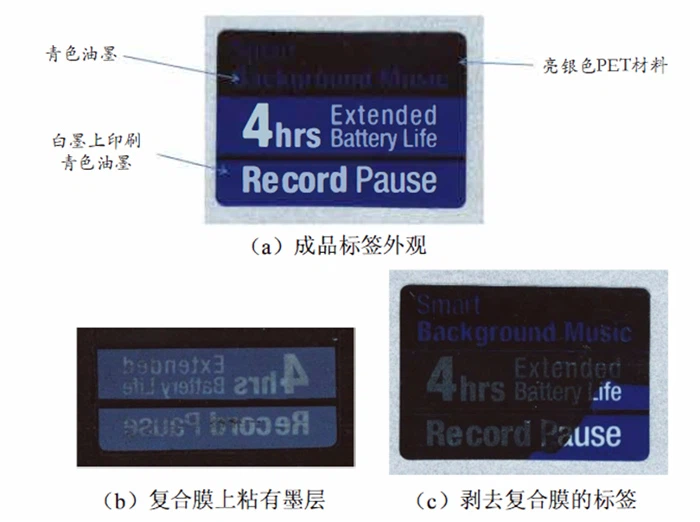
From the scene label samples to view and printing companies and technical personnel to understand the situation can be seen: the label for two-color printing, first printed white ink priming, and then printed cyan text (including Yang text and Yin text). After peeling the BOPP composite film, the material surface of the cyan Yang text did not fall off, the negative part of the white text part of the residue on the surface of the material, while the green ink and white ink overprinted part completely off. This phenomenon shows that: (1) the part of the positive text of the green ink is completely dry and cured, there is no problem of ink loss; (2) the part of the white ink of the negative text is partially cured on the surface of the material, while most of it is not cured and stuck on the composite film; (3) the part of the green ink and white ink overprint is not cured at all and stuck on the composite film all off.
From the analysis of the printing characteristics of PET film material: the ink drop is caused by the white ink on the surface of the film material is not completely dry, because the white ink to achieve the purpose of priming, must have a certain thickness, and white ink within the phthalo white powder, less resin, strong reflection of UV light, poor absorption, so that the ordinary white ink is easy to go wrong. In addition, the label plate structure for the ink layer "bleeding" die-cutting, so the ink layer firmness requirements are higher.
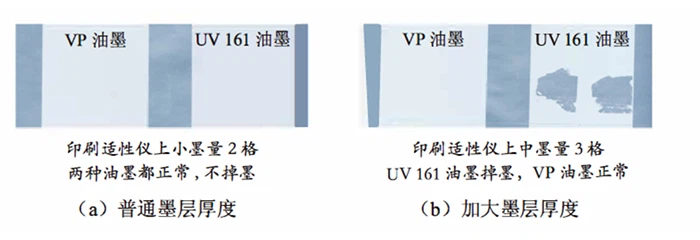
The key to solving this problem is the white ink curing problems. Printing companies use a company's UV161 ink (the ink for general-purpose ink, can print both paper and film), the ink connection material in the resin for domestic ordinary resin, cohesion is small, low tolerance for material coating adaptability. Through comparison test, VP ink is special ink for film printing, and most of the resins in its connecting material are imported special resins, which adapt to all kinds of coatings.
The cohesion between VP ink is very large, even if the ink layer has a certain thickness, in the case of not fully cured, there will be a good bond with the material coating, and there will be no ink drop. Figure 2 shows the test situation of UV 161 ink and VP ink with different thickness of ink layer.
Case two: reduce the thickness of the ink layer to avoid the ink off
A label printing company used a brand of matte silver PET film material to print electrical labels. Without changing any conditions, the die-cutting process revealed that one batch of the material showed ink loss at the die-cutting edge. The label's layout was a bleed structure (see Figure 3). The printing company has doubts about the quality of this batch of materials and hopes to solve the problem as soon as possible.
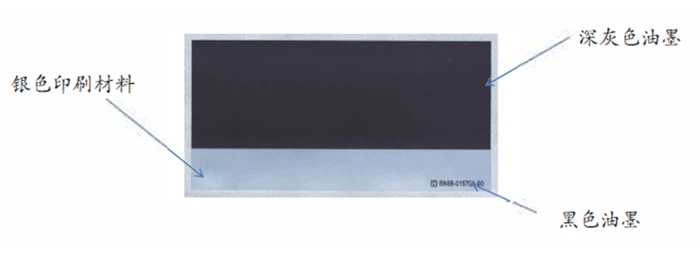
The selected substrate material is PET film material with high-grade coating, as far as the material itself, this phenomenon should not occur. We first analyzed the layout structure of the label: the label for two-color printing, of which gray ink printing twice, black ink printing times, printing color sequence for gray a gray a black, the same ink used is UV161 ink, which spot-color gray ink and black original ink are provided by the ink supplier.
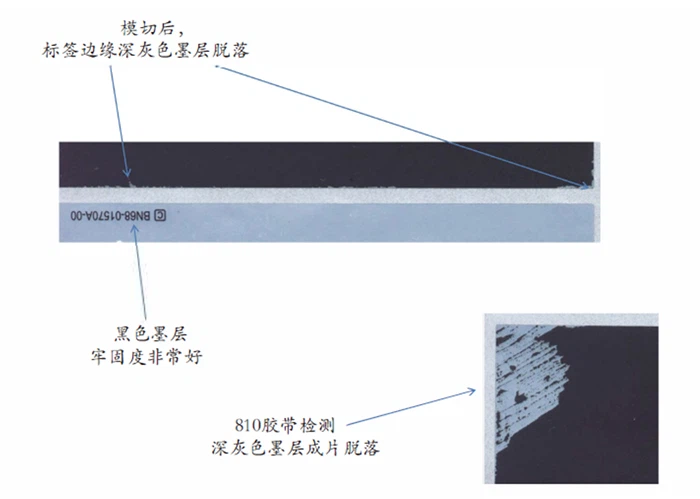
After careful examination of the sample found that: ① test with 3M-810 tape, black ink did not appear deinking phenomenon; ② by the test, gray ink appears obvious cracked shape of a large area off the ink, the label rubbed off the ink more obvious; ③ gray ink die-cut bleeding parts have jagged off the ink phenomenon, see Figure 4. from the above test results can be determined: ① black ink by a set of UV drying and curing device, the ink completely curing, because the amount of ink required for printing text is small, thin ink layer; ② gray ink after three sets of UV curing devices, due to the thick ink layer, UV curing power, ink curing over the head, so that the ink layer brittle phenomenon (also known as aging phenomenon), the edge of the label die-cutting cracking, the phenomenon of ink loss.
To confirm the above inference, a field simulation test was conducted, using the original substrate material remains unchanged, printing on a rotary press, circular knife inline die-cutting. First, the printing of thick ink layer of gray ink, using high-power curing method, the results of the same problem as the label printing company, the label die-cutting edge cracking phenomenon. Then, the use of gray ink thin ink layer, the appropriate way to reduce the curing power printing process, the edge of the label after die-cutting did not appear cracking phenomenon, with the tape detection also did not appear ink loss phenomenon. It can be seen that the ink layer thin, with a stronger combination of materials, and thick ink layer cured, will be mountainous in their own shrinkage, cohesion changes, cracking, resulting in ink off.
It should be noted that printing PET film material on UV letterpress printing machine often ink failure, this is because the thickness of the ink layer can not be guaranteed, changes in equipment speed, pressure changes, changes in the amount of ink storage system will affect the ink layer, so the operator must often observe, check the quality of the label ink situation.