




Why Self-adhesive Label Curling And Not Strong After Laminating?
 Aug 18, 2022|
 Laminating is one of the most common surface finishing processes for sticker label printing, which helps to improve the wear resistance, water resistance, dirt resistance and chemical corrosion resistance of labels. Although the laminating can effectively improve the label grade, but in the process of laminating, often encounter some poor laminating problems, such as wrinkles, bubbles, curling, etc., affect the quality of products, resulting in adverse consequences. In this paper, Yucai printing will share and exchange with you the solution to the problem of Self-adhesive label curling and not strong after laminating.
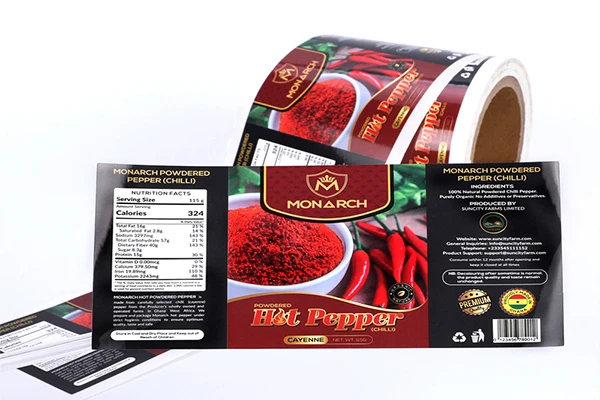
Lamination is Not Firm
The lamination is not strong in daily production often encountered, especially large area of field printing after the film, and the need for bleeding die-cutting adhesive materials, often encountered after die-cutting covered with good film off from the edge, and even the printing ink anti stick down. The reasons for this are as follows:
1. The Quality of the Lamination Itself
If the lamination itself has quality problems, such as glue does not stick, it can not be well pressed together with the printing material. This situation leads to the lamination is not strong, no matter what material, no matter what the printed text and text are easy to fall off. We can do a simple test in the production, that is, after covering the lamination with a utility knife to cover the lamination cut, gently rub a few times to see if the lamination will fall off, if not fall off, generally there will not be too big a problem.
2. Printing Ink Firmness is Not Good
Printing ink is not completely dry, or dry firmness is not good, it is also easy to lead to lamination off. This situation mainly appears in a large area of field printing, and bleeding die cutting products above. Because bleeding die cutting needs to be cut to the ink, if the ink firmness is not good, it is easy to lead to lamination off. In order to avoid this situation, it is recommended to test the firmness of the ink with tape after printing, usually with 3M-610 tape test. If the ink can pass the tape test, then the lamination, die cutting will not appear off phenomenon.
3. The Surface Tension of Printing Materials
The surface tension of some lamination self-adhesive materials is too low, resulting in the inks adhesion after printing is not firm, in the printing of large areas of field patterns after lamination covering bleeding die-cutting prone to film covering phenomenon. In this case, the surface tension of the material must be tested with a tone pen before printing. Generally speaking, the surface tension of the material should reach 38 tones at the minimum and 42 tones at the best. If the material surface tension is too low, it is necessary to consider the mechanical halo, or the way of coating to increase the material surface tension printing. Generally speaking, through these two ways of treatment of the material, surface tension will have different degrees of increase, printing ink attachment is firm, after the sequence of lamination is not easy to fall off the problem. Therefore, we must remember: only after the material surface tension up to sound value qualified, can printing production.

Laminating Impurities
Laminating impurities, refers to the appearance of dirt, foreign matter, dust, etc. in the laminating process, affecting product quality. The main causes of lamination impurities are.
1. The Material Surface Dirty
Self-adhesive material surface dirty, dust, paper hair, paper dust, etc. can easily lead to lamination impurities. Therefore, the production process requires dust removal treatment on the surface of the material. This is usually achieved by dusting cloths or dusting rollers, where the dusting rollers are made of polyurethane rollers with their own weak adhesion to stick down the dust on the surface of the material to reduce the trouble caused by dust during the printing and laminating process. It is worth noting that in recent years, printing presses have made dust removal rollers a standard feature and can be used without much consideration.
In addition, some paper-based self-adhesive materials themselves fall off powder is also easy to lead to lamination impurities, paper powder is often due to the material itself is not strong enough on the surface, with dust removal roller is also difficult to completely remove. If you encounter such a low surface strength of the material, in the case of not being able to replace the material in time, you can consider using the bottom coating way to solve, that is, first in the material surface printing a layer of bottom coating ink or remove the light agent, and then print other colors, which can greatly reduce the generation of paper hair, this way not only can improve the quality of printing, but also greatly improve the quality of the lamination after the sequence.
2. Printing Floating Dust
The environment of the printing workshop has a greater impact on the quality of lamination, if too much dust in the workshop, it is easy to lead to lamination impurities. In principle, the need to change shoes into the printing workshop, at least twice a day to mop the floor, which can ensure that the ground is clean, thereby reducing the workshop dust.
3. Printing Static Electricity
In the printing of film-based self-adhesive materials will generate a lot of static electricity, static electricity will adsorb the dust in the workshop environment, which leads to impurities when laminating. Therefore, in addition to keeping the workshop environment clean, but also need to control the workshop humidity. In principle, the relative humidity of the workshop should be kept at about 50%~60%. It is suggested that enterprises with conditions can buy industrial humidifier to control workshop humidity, and enterprises without conditions can solve the problem by mopping the floor.

Curl after lamination
Curling after lamination is also a common lamination problem. This problem is characterized by hidden, not easy to be found, and so die-cutting curl is often found too late, this problem needs to attract attention. Causes of label curl after lamination are.
1. Laminating Tension
Usually, after the lamination label curl mainly upward curl and downward curl two. If the label curls upward, it means that the membrane tension is too large; if the label curls downward, it means that the membrane tension is too small. In the production process, the tension of the film is constantly changing, generally speaking, when the film is just opened when the tension is relatively small, the more to the heart of the volume, the greater the tension of the film. Therefore, the tension of the film needs to be adjusted during the laminating process. Turn the tension of the film up when you first open the roll, and turn it down when the roll is almost finished.
Here, teach you a way to check whether the lamination tension is appropriate: after lamination with a knife to cover the film material according to the size of the finished label cut a few down, and then the label from the backing paper off to see if the label is flat, if the label is flat, that the membrane tension is appropriate, if the label up or down curl, it means that the membrane tension is not appropriate, you need to adjust the membrane tension according to the specific situation.
2. Equipment Problems
Some old printing equipment on the laminating device, the design is relatively simple, the laminating tension can not be adjusted, or the scope of adjustment is limited. This equipment to the operator will bring some trouble, due to the lack of space for equipment adjustment, once encountered the lamination tension is not appropriate, and can not do effective adjustment, it is easy to lead to lamination curl problem. At present, many new listed printing equipment, its laminating tension is generally adjusted with servo motor, can be a good solution to the problem. This shows that the choice of laminating equipment is also very important.
These are a few of the more common laminating problems and solutions in self-adhesive label web printing. In fact, in the real production process there are many other laminating problems, due to space limitations, here no longer one by one. I hope this article can provide some help to the majority of peers, but also hope that more peers have read this article, you can share your daily production process accumulated valuable experience with everyone.If you have any other questions on adhesive labels ,please feel free contact the label expert or check other news in Yucai printing.